When an investment committee scores a location, it rarely asks what potential the place holds. It asks two things: has capital actually arrived, and is the infrastructure the locality says it is building genuinely under construction? This article answers with published figures rather than adjectives.
Capital Is Arriving, Not Merely Anticipated
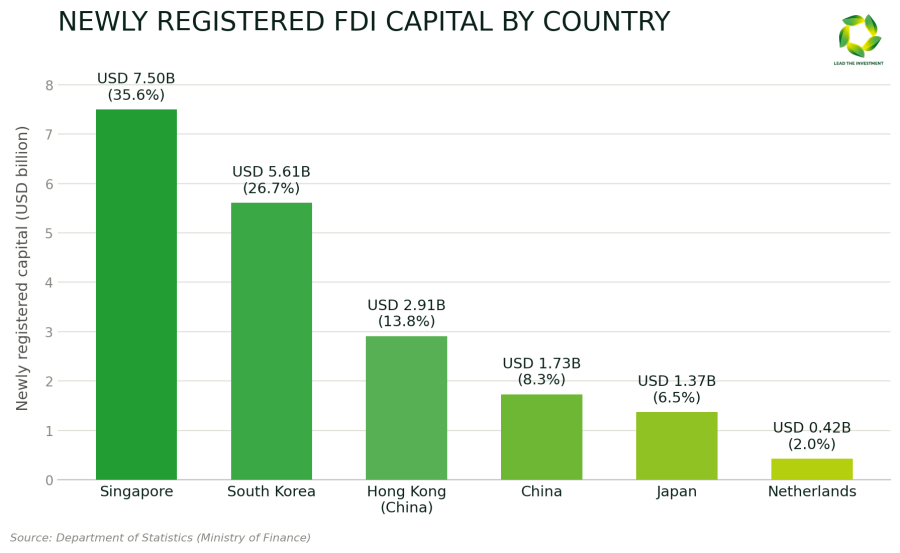
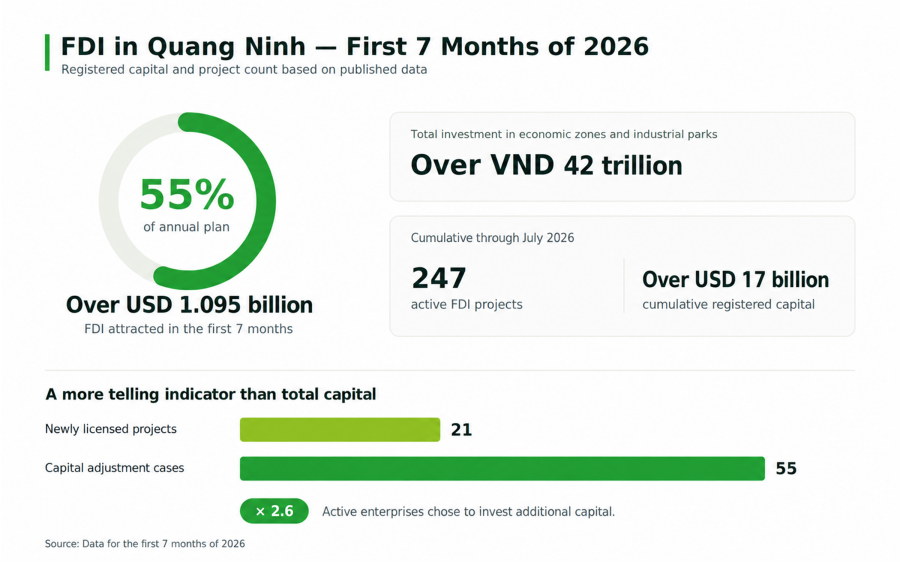
In the first seven months of 2026, Quang Ninh City attracted more than USD 1.095 billion in foreign direct investment (FDI), equivalent to 55% of the target set for the year. Across the same seven months, total investment capital attracted into economic zones and industrial parks in the locality exceeded VND 42,000 billion.
Three figures matter more than the headline total:
The locality’s approach to attracting investment does not stand alone but sits within a national policy framework. Politburo Resolution No. 10-NQ/TW dated 8 June 2026 identifies the foreign-invested sector as an important component of the national economy, linking FDI attraction to the absorption of technology, management practices and human resource development — not simply to the addition of capital.
Governance Quality Has Been Independently Measured for 13 Consecutive Years
Capital figures show that money is arriving. The Provincial Competitiveness Index (PCI) shows why it stays.
In the 2025 Provincial Competitiveness Index report (PCI 2025), released by the Vietnam Chamber of Commerce and Industry (VCCI) on 15 May 2026, Quang Ninh City is among the five localities rated “Good” for governance quality, alongside Bac Ninh, Da Nang, Hai Phong and Phu Tho. This is the 13th consecutive year, from 2013 to 2025, in which the locality has held a place among the country’s top five for economic governance quality.
PCI 2025 was restructured into a 2.0 edition with nine component indices, replacing the absolute ranking from 1 to 34 used over the preceding two decades. Under the new structure, Quang Ninh City ranks third nationally on the Fair Competition index and fourth on the Proactive Government index.
For a foreign investor building a site comparison matrix, these two indices answer two operational questions directly:
- Fair Competition measures the extent to which foreign-invested enterprises and private enterprises are treated on equal terms with preferentially connected enterprises in accessing land, credit and public contracts.
- Proactive Government measures the extent to which administrative agencies take the initiative in resolving obstacles rather than waiting for enterprises to file complaints.
Sustained performance across 13 consecutive years also rules out a single-term achievement. The result spans multiple leadership cycles, consistent with VCCI’s own assessment of this year’s leading five localities: a governance structure balanced across multiple component indices rather than an isolated spike in one area.
External Infrastructure: Open to Traffic, Not on the Drawing Board
This is where the article departs most sharply from most investment promotion material. It draws a clear line between works already in operation and works still under development.
Van Don – Mong Cai Expressway: The Final Piece, in Place Since 2022
The Van Don – Mong Cai Expressway runs approximately 80 km, with total investment capital of nearly VND 13,000 billion, and officially opened to traffic on 1 September 2022. It was the final piece completing the inter-provincial expressway corridor from Hanoi – Hai Phong – Ha Long – Van Don – Mong Cai. At the inauguration, the Prime Minister confirmed that Quang Ninh City’s own expressway network had reached 176 km, or 16% of the country’s total expressway length.
The concrete effect: travel time from Mong Cai to Hanoi fell from 5.5 hours to 3 hours. For a company with a plant in Mong Cai and an operations office in Hanoi, that is the difference between a same-day trip and one requiring an overnight stay.
The expressway also connects directly to three international border gates along the border with China, placing the entire Hai Phong – Quang Ninh –
China border corridor on a single continuous transport axis.
Ben Rung Bridge: A Direct Link to the Quang Yen Area Itself
This is the work with the most direct bearing on the Quang Yen area. The Ben Rung Bridge crosses the Da Bach River, linking Thuy Nguyen District (Hai Phong) with Quang Yen Town (Quang Ninh City). It opened to traffic on 17 July 2024, fully replacing the Rung ferry that had operated on the former National Highway 10 corridor.
The bridge measures 1,865 m in length with a deck width of 21.5 m, at a total investment of nearly VND 1,941 billion (central budget: VND 1,249.5 billion; Hai Phong and Quang Ninh City budgets: VND 691.5 billion). It is the third road corridor linking the two localities, after National Highway 10 and the Bach Dang Bridge.
For companies siting plants in the Quang Yen area, the bridge carries a specific meaning: access to Hai Phong’s industrial areas and seaports — Lach
Huyen among them — no longer depends on a ferry, but runs over a permanent bridge with four motor vehicle lanes.
Lach Huyen Port: The Largest Deep-Water Port in the North, Expanding Next Door
Lach Huyen lies outside Quang Ninh City’s administrative boundary, but it is the nearest deep-water port and the highest-capacity one serving the entire Hai Phong – Quang Ninh corridor. It is also in its fastest expansion phase to date:
The most notable point: Berths 3 and 4 are operated by a joint venture between Hai Phong Port and Terminal Investment Limited, the port operating subsidiary of Mediterranean Shipping Company (MSC), the world’s largest shipping line. Direct investment in terminal operations by the world’s largest container carrier says more than any planning figure: it is a commercial judgment by the international shipping industry itself on cargo prospects through this area.
Van Don International Airport: Vietnam’s First Private Airport, Reopening Routes
Van Don International Airport is the first privately invested airport in Vietnam, built to Category 4E standards of the International Civil Aviation
Organization (ICAO) and in commercial operation since 2018. Its runway is 3.6 km long and can accommodate wide-body aircraft such as the Airbus
A350, Boeing 777 and Boeing 787.
Current terminal capacity is 2.5 million passengers per year. Under the vision to 2050 submitted by the Civil Aviation Authority of Vietnam to the
Ministry of Construction, capacity would rise to approximately 20 million passengers and 200,000 tonnes of cargo per year.
On actual operations: the Ho Chi Minh City – Van Don route entered commercial service on 15 June 2026 (Sun PhuQuoc Airways, four return flights per week), with a load factor above 90% on its first day. In parallel, the airport continues to operate international charter flights to Shenzhen (China) and destinations in South Korea.
Con Ong – Hon Net Port: A Project at the Study Stage, Not Yet Built
This is the highest-potential infrastructure on the list, and it must be presented at its actual stage. The Con Ong – Hon Net port area, on the southern side of Bai Tu Long Bay, has a natural deep channel of -7 m to -13.4 m and is sheltered from wind by surrounding islands — rare natural conditions for forming a deep-water port able to receive container vessels of up to 100,000 tonnes and bulk carriers of up to 200,000 tonnes.
On 16 April 2026, the Quang Ninh City Department of Construction and the Northeast Maritime Institute (NMI, United States) signed a memorandum of understanding on strategic cooperation to study implementation of the project under a public-private partnership (PPP) model. This is the first formal step.
A Physical Bridge Between Vietnam, China and ASEAN
Quang Ninh City is the only locality in northern Vietnam where four transport modes converge in the same territory: expressway road, international sea, air, and international land border gates with China.
Situated within the Hanoi – Hai Phong – Quang Ninh economic triangle, the locality acts as a bridge between Vietnam’s domestic market, China and the ASEAN region. For export manufacturers, this multimodal structure has a concrete operational meaning: when one transport route is disrupted — port congestion, weather or an infrastructure failure — an alternative remains available within the same territory, instead of full dependence on a single gateway. This criterion is increasingly built into the supply chain risk assessments of Japanese and European corporations.
Incentive Policy: A Specific Legal Framework
The Law on Corporate Income Tax No. 67/2025/QH15 took effect on 1 October 2025, setting out a clear incentive framework for investment projects in economic zones:
- Projects in economic zones located in an area eligible for tax incentives: existing incentive levels are retained — a 10% tax rate for 15 years (Point d, Clause 1, Article 13), followed by a 4-year exemption and a 50% reduction of the payable tax for the next 9 years (Clause 1, Article 14).
- Projects in economic zones not located in an area eligible for tax incentives: a preferential tax rate of 17% for 10 years (Clause 4, Article 13), followed by a 2-year exemption and a 50% reduction of the payable tax for 4 years (Clause 2, Article 14).
The areas qualifying as “an area eligible for tax incentives” are defined at Points a and b, Clause 3, Article 12 of the same law.
The law also adds new business lines eligible for investment incentives (Clause 2, Article 12), including digital technology services, cybersecurity, semiconductor chips, data centers and artificial intelligence — precisely the sectors toward which Quang Ninh City is actively steering FDI, under the “high-quality FDI” orientation the locality announced in 2026.
A Labor Pool That Extends Beyond Administrative Boundaries
Quang Ninh City has a young workforce alongside a developing system of universities, colleges and vocational training institutions. The real advantage, however, is geographic: direct adjacency to Hai Phong allows companies to draw on a cross-provincial labor pool from Hai Phong, Hai
Duong, Bac Ninh, Hung Yen and Hanoi, rather than depending entirely on local supply.
This is a particular advantage for processing and manufacturing industries, high technology and logistics — sectors that need to recruit in large numbers over a short period as plants come into operation.