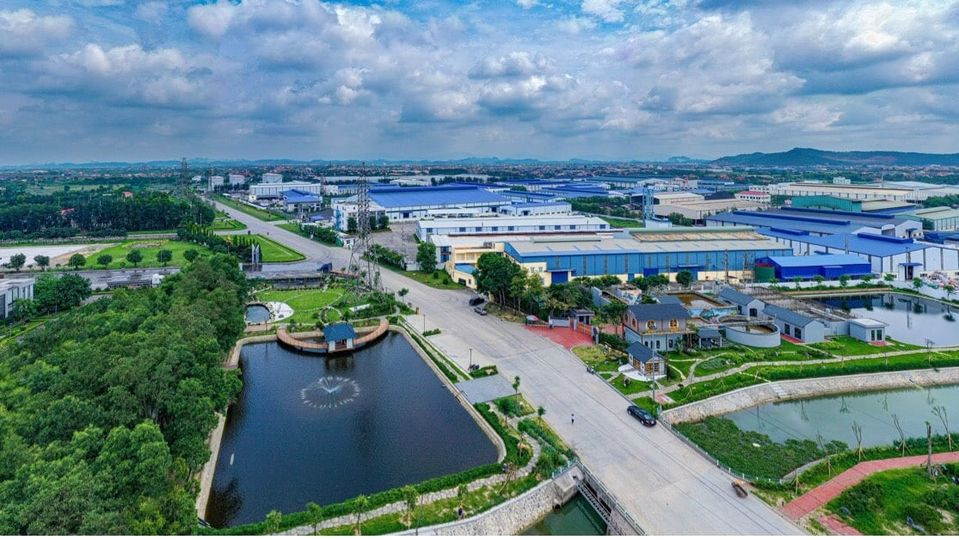
For export manufacturers, environmental, social and governance (ESG) performance is increasingly tied directly to customer orders. Choosing an industrial park is no longer only a question of location and cost. VB Quang Yen Industrial Park in Quang Ninh addresses these requirements at the planning stage, from wastewater treatment, green space and flood protection to the power supply that each manufacturer will rely on.
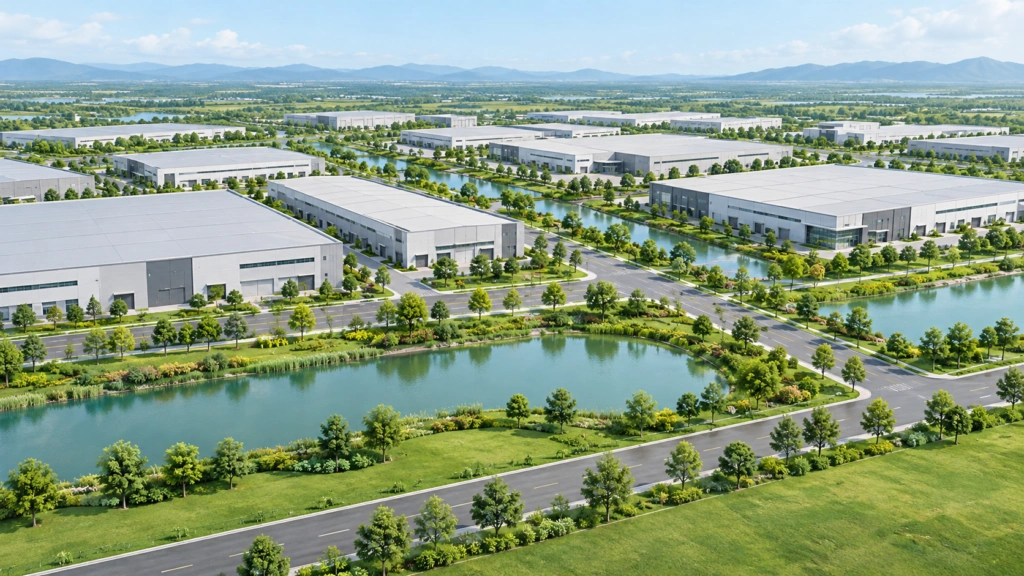
Illustration: an industrial park with green space and water surface.
When ESG becomes a selection criterion in global supply chains
Vietnam has committed to reaching net-zero emissions by 2050. The pledge was announced at COP26 and set out in the national climate change strategy through 2050 (Decision No. 896/QD-TTg dated 26 July 2022 of the Prime Minister). At the same time, a growing number of multinational groups expect their suppliers to show that they control wastewater, waste and emissions.
For manufacturers, that puts an industrial park's environmental infrastructure squarely in the frame: it affects how easily a company can meet its customers' requirements. A plant in a park with compliant, continuously monitored wastewater treatment is better placed when supplier audits come around.
VB Quang Yen Industrial Park covers 407.71 ha and is being developed by VB Nha Mac Joint Stock Company, the licensed project investor, under Decision No. 335/QD-BQLKKT dated 28 June 2026 of the Quang Ninh Economic Zone Authority. The project takes this approach from the planning stage, starting with the 1/2,000 zoning plan approved under Decision No. 402/QD-BQLKKT dated 31 July 2026.
Wastewater and waste controlled at the source
Under the approved plan, wastewater at VB Quang Yen Industrial Park is designed to be managed in three stages:
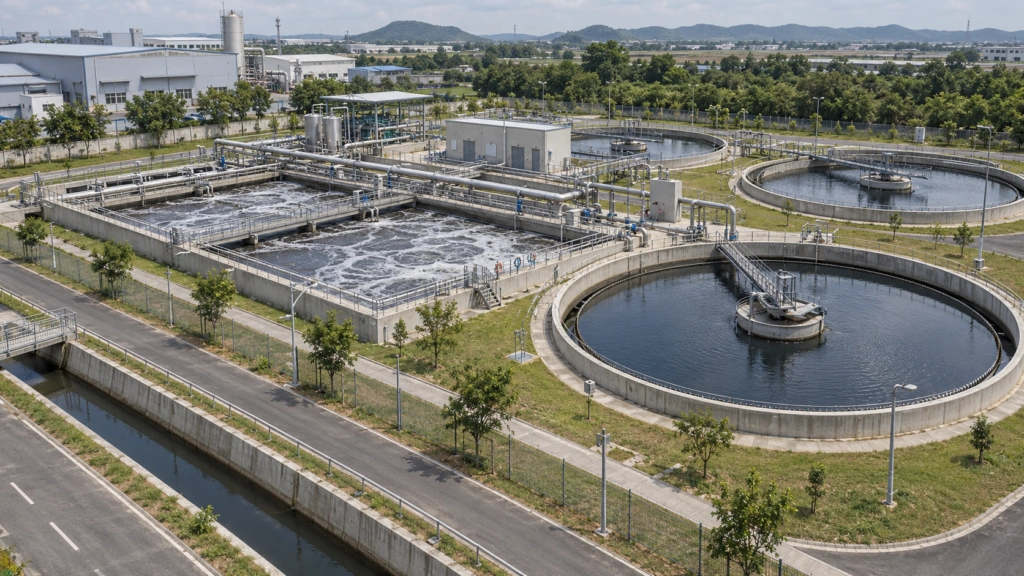
Illustration: a centralized wastewater treatment plant in an industrial park.
For solid waste, the plan provides for sorting at source. Hazardous waste is to be stored separately and transported for treatment on a regular schedule.
The plan also sets aside 40.8 ha of public green space (10.01% of the park's area), together with 4.49 ha of water surface, to form an ecological buffer between production zones.
Planning ahead for storm tides and climate change
VB Quang Yen Industrial Park lies within the Quang Yen Coastal Economic Zone, beside the Bach Dang River. Its climate adaptation measures start with site grading:
- Dike D1: crest elevation of +4.50 m, above the historical peak tide of +3.3 m (recorded during the 1971 storm).
- Site grading: control elevations set between +3.43 m and +4.50 m (Hon Dau elevation datum).
- Stormwater drainage: fully separate from the wastewater system, designed for a 10-year rainfall return period, and discharging into the Bach Dang River through the canal system around the project.
For sectors with sensitive equipment, such as electronics, components and precision engineering, flood risk is a key factor in site assessment. A proactive flood-control design helps investors reduce the long-term risk of production disruption.
Reliable power for each plant's emissions-reduction pathway
The plan provides for power from a planned 110/22 kV substation with 3 × 63 MVA capacity, sized for a total demand of about 165.14 MVA, based on 500 kW per hectare of production land. Internal roads are planned with energy-saving LED lighting. Secondary investors may install rooftop solar for their own use, helping to cut emissions in plant operations.
A dependable power supply gives each company room to pursue its own emissions-reduction roadmap on its own timeline, in line with the requirements of its customers and export markets.
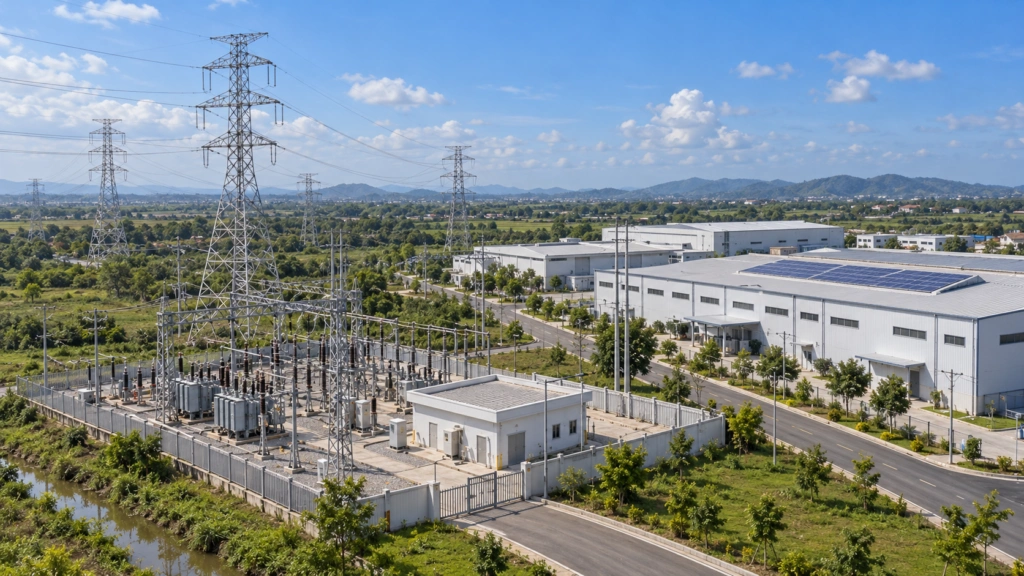
Illustration: a substation, power transmission system and rooftop solar.
Park design measured against Vietnamese and international benchmarks
To help investors evaluate the park, the table below sets its planned environmental and climate parameters against three sets of reference standards:
- Vietnam's mandatory technical regulations (QCVN).
- Guidance on developing eco-industrial parks under Decree No. 35/2022/ND-CP and Circular No. 05/2025/TT-BKHDT.
- The International Framework for Eco-Industrial Parks, Version 2.0, published in 2021 by UNIDO, the World Bank Group and GIZ.
These figures are design parameters under the 1/2,000 zoning plan (Decision No. 402/QD-BQLKKT). Actual performance will be determined once the infrastructure is completed and in operation.
Sustainability beyond infrastructure
Local employment. According to the planning dossier, the park is projected to require a workforce of 24,000–34,000 at full operation, which would add momentum to growth in western Quang Ninh.
Transparent governance. The project is being developed on a clearly published legal basis: Decision No. 335/QD-BQLKKT on investment policy approval and Decision No. 402/QD-BQLKKT on the 1/2,000 zoning plan. Investors can check project information against these documents during due diligence.
Long-term partnership. VB Holdings and the project team support investors from site research and investment procedures through construction, operation and expansion. The plan also reserves 20.13 ha for high-tech enterprises, small and medium-sized enterprises and innovative companies, under Clause 4, Article 7 of Resolution No. 198/2025/QH15.
Ground broken, infrastructure to be delivered in phases
VB Quang Yen Industrial Park broke ground on 27 August 2026. Under Decision No. 335/QD-BQLKKT, construction is to be completed within 48 months of land handover. The infrastructure described in this article is being delivered in line with the plan and the project's investment schedule.
Frequently asked questions
1. Which standard applies to wastewater at VB Quang Yen Industrial Park?
Under the approved plan (Decision No. 402/QD-BQLKKT), wastewater is to be fully collected and sent to a centralized treatment plant with a capacity of 15,000 m³/day. Effluent is designed to meet QCVN 40 Column A and to be monitored automatically.
2. Do secondary investors have to treat their own wastewater?
Companies pre-treat their wastewater to the park's connection requirements. It then goes to the centralized treatment plant.
3. Is the park at risk of flooding from storm tides?
Dike D1 is designed at +4.50 m, above the historical peak tide of +3.3 m. Stormwater drainage is fully separate and designed for a 10-year rainfall return period.
4. Can companies install rooftop solar?
Yes. Secondary investors may install rooftop solar for self-consumption, supporting each plant's emissions-reduction roadmap.
5. What stage is the project at?
The project broke ground on 27 August 2026. The infrastructure is being developed in line with the plan and the investment schedule.
Explore the park's infrastructure and ESG approach
Contact our investment advisory team for the master plan, technical infrastructure specifications and a site visit schedule.