From the 2025 tax period, location-based corporate income tax (CIT) incentives are determined under Law No. 67/2025/QH15 on Corporate Income Tax. The list of tax-incentive areas comprises areas with difficult and extremely difficult socio-economic conditions and certain functional zones, including economic zones. Industrial parks are not on this list. For investors choosing a factory location, the question of whether an industrial park lies within an economic zone has therefore become a tax question. In this article, VB Holdings sets out the incentive framework for new investment projects in economic zones, how incentive periods are calculated, the conditions that must be met, and what this means for investors at VB Quang Yen Industrial Park.
Tax-incentive areas under Law 67/2025/QH15
Law No. 67/2025/QH15 on Corporate Income Tax (PDF) took effect on 1 October 2025 and applies from the 2025 CIT period (Clause 1, Article 19). Several articles of the Law have been amended and supplemented by Laws No. 116/2025/QH15, 127/2025/QH15, 133/2025/QH15, 141/2025/QH15 and 143/2025/QH15; the consolidated text was issued by the Office of the National Assembly as Consolidated Document No. 61/VBHN-VPQH dated 23 March 2026. This article cites the original text of the Law as passed by the National Assembly on 14 June 2025; when applying it to a specific project, investors should also refer to the consolidated document above.
Under Clause 3, Article 12 of the Law, CIT-incentive areas comprise:
- Areas with extremely difficult socio-economic conditions (Point a).
- Areas with difficult socio-economic conditions (Point b).
- Economic zones, high-tech zones, high-tech agricultural zones and concentrated digital technology zones (Point c).
Industrial parks are not on this list. This is a point to distinguish from Law on Investment No. 143/2025/QH15 (PDF). Under Point b, Clause 2, Article 15 of the Law on Investment, industrial parks and economic zones are both "areas eligible for investment incentives". However, Clause 6, Article 14 of the Law on Investment provides that the specific level of each type of investment incentive is applied in accordance with the laws on tax, accounting and land. In other words, a project may be located in an area eligible for investment incentives under the Law on Investment, while its CIT incentive level must still be determined under Law 67/2025/QH15.
For reference, the standard CIT rate is 20% (Clause 1, Article 10). The Law also provides rates of 15% and 17% for enterprises with small total annual revenue (Clauses 2 and 3, Article 10). These are separate cases and are unrelated to the 17% incentive rate for projects in economic zones discussed below.
Incentive framework for new investment projects in economic zones
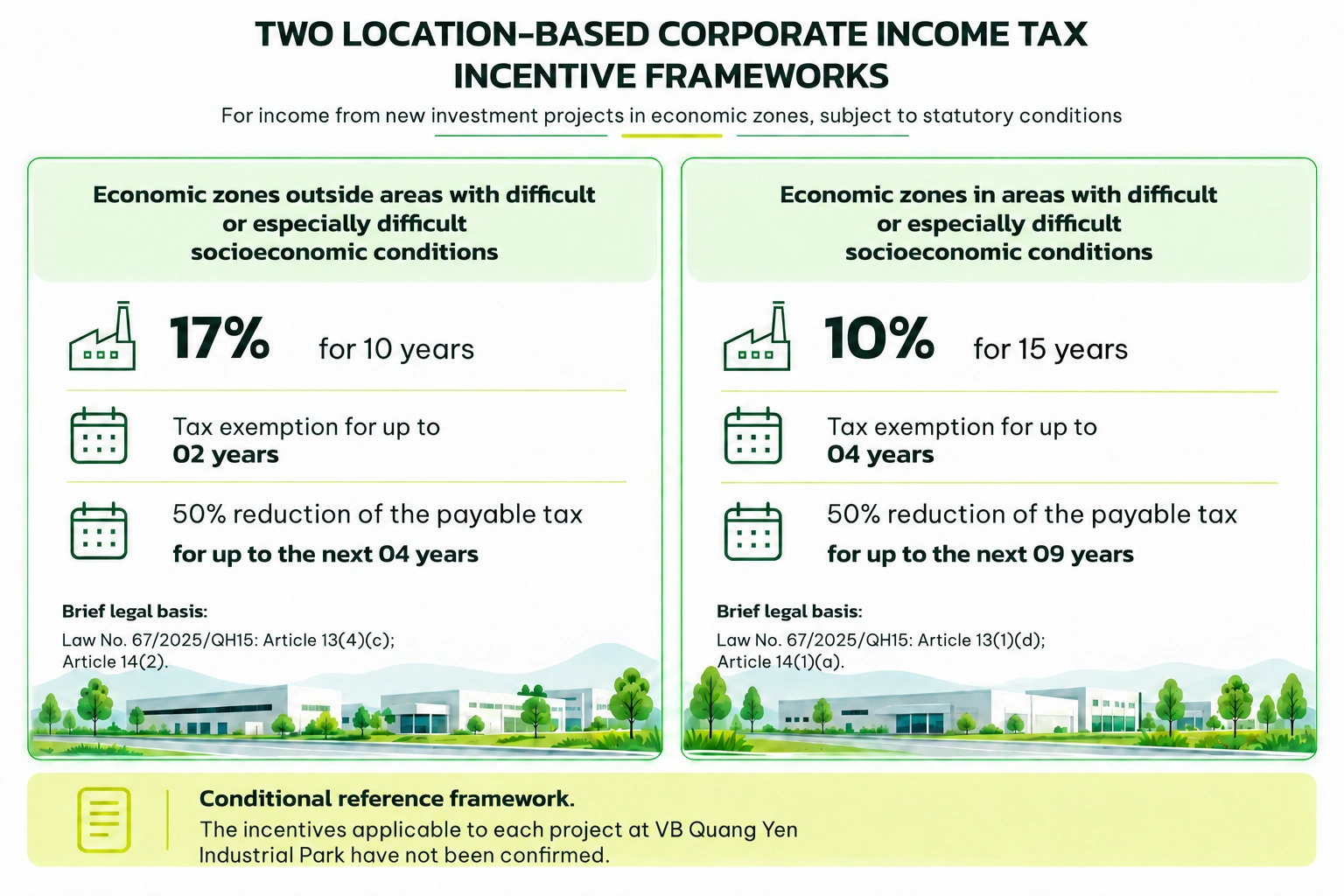
Law 67/2025/QH15 and Decree No. 320/2025/ND-CP (PDF) divide new investment projects in economic zones into two cases, depending on whether the project is located in an area with difficult or extremely difficult socio-economic conditions.
Note on wording: the qualifier "maximum", rendered above as "up to", is the wording of Law 67/2025/QH15 (Clauses 1 and 2, Article 14). Decree No. 320/2025/ND-CP (Clauses 1 and 2, Article 20) states the exemption and reduction periods as "02 years" and "04 years" (or "04 years" and "09 years") without the word "maximum".
For projects located across both types of area, Decree No. 320/2025/ND-CP provides as follows: a new investment project in an economic zone with more than 50% of its area located in a tax-incentive area (an area with extremely difficult or difficult socio-economic conditions) falls under the 10%-for-15-years framework (Point d, Clause 1, Article 19); a project with more than 50% of its area located outside tax-incentive areas falls under the 17%-for-10-years framework (Point c, Clause 4, Article 19). The documents cited in this article do not separately address a project whose area is split exactly 50–50.
This article analyzes incentives by location criteria only. Law 67/2025/QH15 also provides sector-based incentives (Clause 2, Article 12), which may carry their own preferential rates regardless of location; that topic is outside the scope of this article.
Two reference points: the first year with revenue and the first year with taxable income
A point investors often misunderstand is that the preferential-rate period and the tax exemption and reduction period do not necessarily start in the same year.
The preferential rate runs from the first year with revenue. Under Clause 7, Article 13 of Law No. 67/2025/QH15 and Clause 7, Article 19 of Decree No. 320/2025/ND-CP, the period for applying the preferential tax rate to income from a new investment project is counted from the first year in which the project generates revenue.
Exemption and reduction run from the first year with taxable income. Under Clause 4, Article 14 of Law No. 67/2025/QH15, the tax exemption and reduction period is counted from the first year in which the project earns taxable income. If the project has no taxable income in the first 3 years from the first year with revenue, the exemption and reduction period is counted from the 4th year.
In practice, a new factory usually generates revenue before it becomes profitable. In that case, the 10-year preferential-rate clock has already started while the exemption and reduction period has not. Investors should build this factor into their financial model from the project preparation stage.
Illustrative example
Strategic assessment — hypothetical example, not a commitment.
Assume a new investment project in an economic zone under the 17%-for-10-years framework; the first year with revenue is also the first year with taxable income; the enterprise receives exemption and reduction periods at the maximum level under the Law; and from year 11, the enterprise does not qualify for the 15% or 17% rates for enterprises with small total revenue (Clauses 2 and 3, Article 10) and has no other incentives. The effective tax rate by year is as follows:
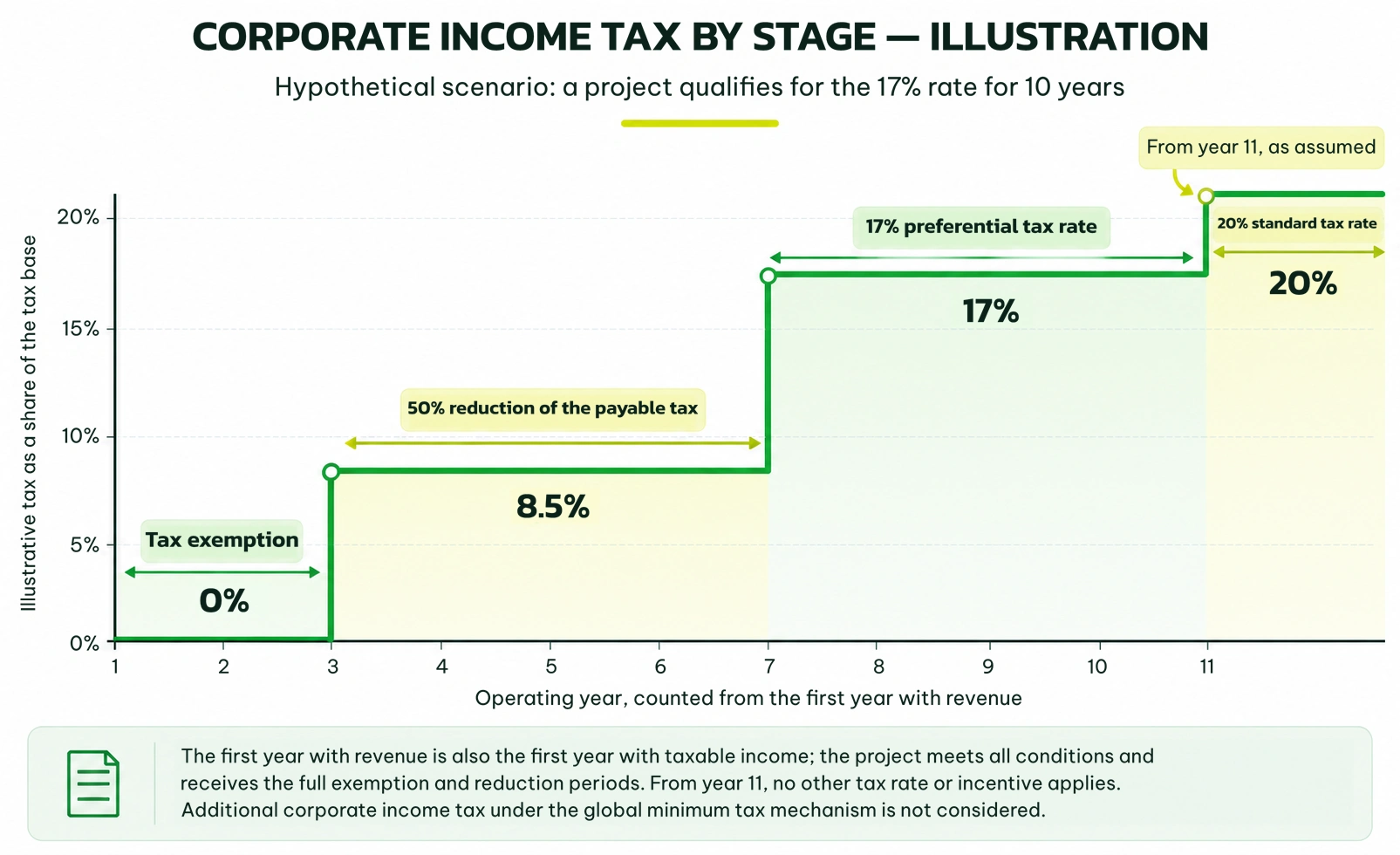
Second hypothetical example (same label: strategic assessment, not a commitment). If the project generates revenue from year 1 but only earns taxable income from year 3, the exemption and reduction period is counted from year 3: tax exemption in years 3–4 and a 50% reduction in years 5–8. In years 1–2 the project has no taxable income, so no tax arises. The 17% rate still runs from year 1 and ends at the end of year 10, so in years 9–10 the enterprise pays the full 17%; from year 11 the standard rate applies.
Under the 4th-year rule (Clause 4, Article 14), the exemption and reduction period starts no later than the 4th year. Under the 17%-for-10-years framework, the 50% reduction period therefore ends no later than the 9th year and does not extend beyond the preferential-rate period. The actual outcome for each project depends on the years in which revenue and taxable income arise and on whether the incentive conditions are met.
Conditions for obtaining and retaining incentives
Tax incentives do not apply automatically to every project located in an economic zone. Article 18 of Law No. 67/2025/QH15 sets out the following main conditions:
- Accounting regime and tax payment method. Incentives apply only to enterprises that comply with the accounting, invoice and document regimes and pay tax under the declaration method (Clause 1).
- New investment projects. Incentives for new investment projects do not apply to mergers, consolidations, divisions, separations, changes of ownership, conversions of enterprise type and other cases prescribed by the Government (Clause 1).
- Separate accounting. Enterprises must account separately for income from incentivized activities and income from non-incentivized activities. If separate accounting is not possible, incentivized income is determined in proportion to revenue or expenses (Clause 2).
- Consequences of non-compliance. The competent authority recovers the tax and imposes penalties in accordance with regulations (Clause 5).
Law on Investment No. 143/2025/QH15 adds two important principles. Investment incentives are applied for a limited period on the basis of project implementation results, and investors must satisfy the conditions throughout the incentive period (Clause 8, Article 14). Where a project qualifies for several different incentive levels, the highest level applies (Clause 9, Article 14).
On procedures, under Circular No. 20/2026/TT-BTC dated 12 March 2026 of the Ministry of Finance, enterprises determine for themselves whether they meet the incentive conditions, and declare and finalize tax with the tax authority; the tax authority inspects and takes action where an enterprise does not meet the conditions.
Cases where incentives do not apply
Clause 3, Article 18 of Law No. 67/2025/QH15 excludes certain types of income from incentives, even where the enterprise is located in an economic zone. Of particular relevance to industrial investors:
- Income from capital transfers, transfers of capital contribution rights, real estate transfers and transfers of investment projects (with certain exceptions provided in this Clause).
- Income from production and business activities outside Vietnam.
- Income from producing and trading goods and services subject to special consumption tax, except projects producing or assembling automobiles, aircraft, helicopters, gliders and yachts, and oil refining and petrochemical projects.
- Income from the exploration and extraction of oil and gas, precious and rare natural resources and minerals, and other cases specified in this Clause.
From the perspective of the Law on Investment, Clause 7, Article 14 of Law on Investment No. 143/2025/QH15 provides that investment incentives based on areas eligible for investment incentives do not apply to mineral extraction projects; projects producing or trading goods and services subject to special consumption tax (except projects manufacturing automobiles, aircraft and yachts); and commercial housing construction projects.
Expansion investment projects
Clause 5, Article 14 of Law No. 67/2025/QH15 contains specific provisions for expansion investment projects in incentivized sectors or areas. If the existing project still has a remaining incentive period, the additional income from the expansion receives the existing project's incentives for the remaining period. If the existing project's incentive period has expired, additional income that meets the statutory criteria qualifies for tax exemption and reduction but not for a preferential tax rate. These incentives do not apply to expansions resulting from the merger or acquisition of an enterprise or an operating project (Point c, Clause 5). Investors planning phased expansion should check this provision when preparing their investment roadmap.
Note for groups within the scope of the global minimum tax
For multinational groups within the scope of the global minimum tax, the actual effect of tax incentives in Vietnam needs to be considered together with the top-up corporate income tax mechanism under Resolution No. 107/2023/QH15 and Decree No. 236/2025/ND-CP. We will analyze this topic in the article [LINK PENDING — Global minimum tax: what multinational groups need to consider when receiving tax incentives in Vietnam].
Application at VB Quang Yen Industrial Park
VB Quang Yen Industrial Park is located within Quang Yen Coastal Economic Zone, whose master plan was approved under Decision No. 828/QD-TTg dated 11 May 2026 of the Prime Minister. The project's legal framework is presented in the article [Legal framework of VB Quang Yen Industrial Park: understanding Decisions 335, 402 and 828](LINK ARTICLE 01 — EN).
The incentive framework that VB Holdings uses in the VB Quang Yen Industrial Park Investment Profile is the one for new investment projects in economic zones not located in areas with difficult or extremely difficult socio-economic conditions: a 17% tax rate for 10 years, a tax exemption for up to 2 years and a 50% reduction of the payable tax for up to the next 4 years (Point c, Clause 4, Article 13 and Clause 2, Article 14 of Law No. 67/2025/QH15). The incentive area and the specific incentive level of each project are determined by the competent tax authority and investment registration authority.
Note that the incentives above apply to income from the projects of secondary investors that locate their factories in the industrial park. They are distinct from the incentives for the infrastructure investment project of VB Nha Mac Joint Stock Company, the licensed project investor approved to implement the industrial park project under Decision No. 335/QD-BQLKKT dated 28 June 2026. The roles of the two parties are explained in the article [Infrastructure developer and secondary investors](LINK ARTICLE 02 — EN).
Our investment team can provide the Investment Profile, which includes an Investment Incentives section, and guide investors in preparing information for their discussions with a tax advisory firm.
Frequently asked questions
1. Are industrial parks still CIT-incentive areas under Law 67/2025/QH15?
Under Clause 3, Article 12 of Law No. 67/2025/QH15, tax-incentive areas comprise areas with difficult and extremely difficult socio-economic conditions, and economic zones, high-tech zones, high-tech agricultural zones and concentrated digital technology zones. Industrial parks are not on this list.
2. What preferential tax rate applies to new investment projects in economic zones?
New projects in economic zones not located in areas with difficult or extremely difficult socio-economic conditions are subject to a 17% rate for 10 years (Point c, Clause 4, Article 13). New projects in economic zones located in areas with difficult or extremely difficult socio-economic conditions are subject to a 10% rate for 15 years (Point d, Clause 1, Article 13).
3. How long is the exemption and reduction period for projects under the 17% framework?
A tax exemption for up to 2 years and a 50% reduction of the payable tax for up to the next 4 years, under Clause 2, Article 14 of Law No. 67/2025/QH15.
4. When do incentive periods start?
The preferential rate runs from the first year in which the project generates revenue (Clause 7, Article 13). The exemption and reduction period runs from the first year with taxable income; if there is no taxable income in the first 3 years from the first year with revenue, it runs from the 4th year (Clause 4, Article 14).
5. Do enterprises need to obtain confirmation of incentives in advance?
Under Circular No. 20/2026/TT-BTC, enterprises determine for themselves whether they meet the incentive conditions, and declare and finalize tax with the tax authority. If the conditions are not met, the competent authority recovers the tax and imposes penalties under Clause 5, Article 18 of Law No. 67/2025/QH15.
6. Do the tax incentives apply to the infrastructure developer of VB Quang Yen Industrial Park?
This article covers incentives for the projects of secondary investors that locate their factories in the industrial park. Incentives for the infrastructure project implemented by VB Nha Mac Joint Stock Company are determined separately in accordance with the law.
References (downloads)
Conclusion
Law No. 67/2025/QH15 makes location within an economic zone the decisive factor in accessing location-based tax incentives. For new investment projects in economic zones not located in areas with difficult socio-economic conditions, the incentive framework is a 17% tax rate for 10 years, a tax exemption for up to 2 years and a 50% reduction of the payable tax for up to the next 4 years. To obtain and retain these incentives, enterprises need to understand the two reference points for calculating incentive periods, meet the conditions in Article 18 and maintain them throughout the incentive period.
VB Quang Yen Industrial Park is located within Quang Yen Coastal Economic Zone. We recommend that investors build these provisions into their financial models from the site selection stage, and consult an independent tax advisory firm to determine the specific incentive level for their project.
Investors who need the Investment Profile or wish to discuss incentive policies for a specific project are invited to contact VB Holdings' investment team or learn more about VB Quang Yen Industrial Park.
This content is for reference only and does not replace tax or legal advice. The actual incentive level of each project is determined by the competent tax authority and investment registration authority. Investors should consult an independent tax advisory firm before making decisions.